
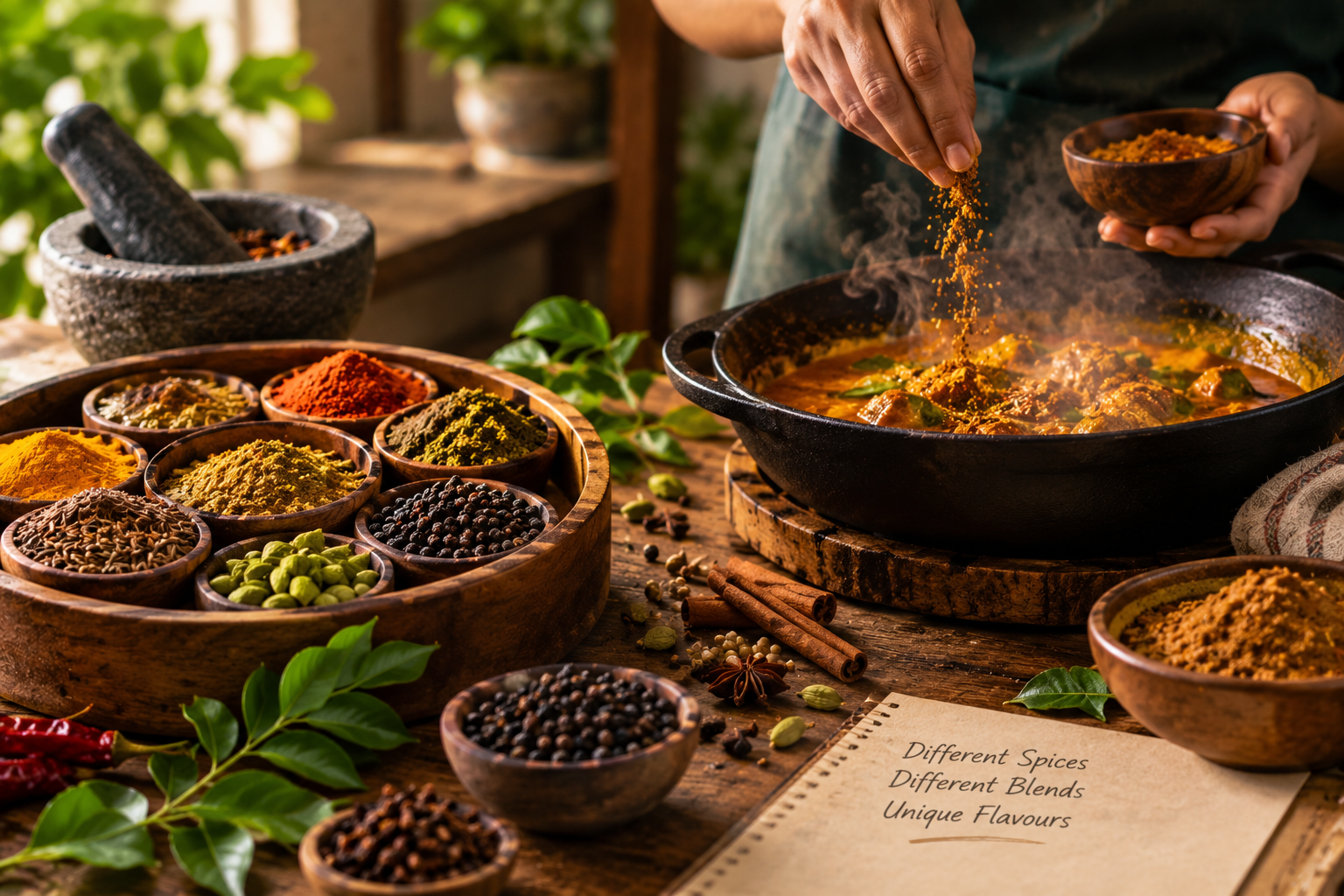
How Different Masala Blends Create Different Flavours in Indian Cuisine
There's a thing that happens in Indian homes where you know what's for dinner before you've even taken your shoes off at the door. The smell reaches the gate first. That's masala at work, quietly doing most of the heavy lifting before the food's even plated.
We say "masala" like it's one fixed thing, a single recipe everyone agrees on. It's not, not even close. Every region has its own version, and honestly, every household tends to tweak it a little further. Once you start paying attention to what's actually going into these blends, food starts making a different kind of sense. Not just what you're eating, but why it tastes like that and not something else.
What is a masala blend, really
At the core of it, a masala blend is just spices put together to make something none of them could pull off alone. Some are dry, roasted ahead of time and ground into a powder that sits in a tin for weeks. Others are wet pastes, thrown together fresh with ginger, garlic, green chilli right before the pan goes on. Different form, same purpose, get the spices working together instead of just next to each other.
It helps to think of it like music. One note is fine, but a chord does something a single note never could. Cumin on its own is earthy, a little plain if we're being honest. Coriander by itself is light, faintly sweet, not much to talk about. Combine the two, add some chilli for heat, a bit of turmeric for colour, and suddenly there's actual movement in the flavour. It changes as it sits on your tongue instead of just being one note the whole way through.
This is also why two people can start with almost identical spice boxes and end up somewhere completely different. The ratio matters more than people assume. So does the order things go into the pan. Even whether you use a spice whole or ground changes what you actually taste at the end.
Getting to know the individual spices
Before getting into the blends themselves, it helps to know what each spice is actually doing.
Cardamom is sweet and floral, with something cool running underneath it. It's the smell that makes biryani feel like an occasion, and somehow the same pod works just as well dropped into evening chai. Not a lot of spices manage that kind of range.
Cumin is warm, nutty, a bit smoky once it's toasted. It's usually the first thing to go into hot oil, that quick crackle before anything else happens in the pan. Everything that follows is really just building on whatever cumin sets up first.
Coriander seed, the seed, not the leaf, that's an entirely different job, is mild and faintly citrusy. Funny thing is, nobody ever calls it their favourite. Ask what they'd miss most if it disappeared, though, and this is usually the answer. It softens the sharper spices, gives cumin something to sit against, keeps the louder ones from talking over each other.
Black pepper brings its own kind of heat, sharper and quicker than chilli, and it tends to land at the back of your throat rather than sit on your tongue.
Cloves are intense, almost too much if you're careless with them. Handled well, though, they bring a warmth nothing else quite matches.
And cinnamon, the real Ceylon kind especially, smooths the whole thing over. It softens what clove and pepper bring so it doesn't feel sharp.
Each one is interesting enough on its own. Together, they turn into something none of them could be alone.
The blends most people already know
Garam Masala is probably the name most people recognise, even outside India. It's usually cardamom, cinnamon, cloves, pepper, and cumin, sometimes with a couple of extras depending on which kitchen you're standing in. It tends to go in near the end of cooking, almost like a last touch, so the smell stays fresh rather than getting cooked out over an hour on the stove.
Biryani Masala carries a heavier load. It has to stand up to rice, meat, and hours of slow steaming, so it's built bolder, star anise, mace, more cardamom and cinnamon than garam masala would use. It's less about being subtle and more about that smell filling the whole house before anyone's even lifted the lid.
Sambar Masala goes a completely different direction. Toor dal, dried red chillies, coriander seed, a good amount of fenugreek, that combination is what gives sambar its slightly bitter, tangy comfort. It's a South Indian everyday staple for a reason. Something about it turns plain lentils and vegetables into a dish you genuinely don't get tired of, even eating it three times a week.
And then there's Kerala
Kerala deserves its own space here, because its relationship with spices goes deeper than most places manage. This is, after all, where black pepper comes from originally. It shows in everything the state cooks.
Kerala-style masalas lean heavily on pepper, curry leaves, and coconut, layered over the usual coriander-cumin foundation. Dishes like fish curry or beef ularthiyathu use blends that are earthier and spicier than what you'd find further north, usually finished off with mustard seeds and curry leaves tempered in hot coconut oil. Less sweetness, more heat, and a smoky depth that only comes from roasting whole spices before grinding. You can't fake that by just throwing in extra chilli powder.
If you've ever wondered why Kerala food tastes so different even when the ingredient list looks familiar, that's the answer sitting right there. It's not only what goes into the blend. It's how it's roasted, how fine or coarse it's ground, and the coconut oil quietly doing its job underneath.
How you handle the masala matters more than people think
Here's something that doesn't get said enough: the exact same spice mix can taste like two entirely different things depending on technique.
Roasting before grinding releases oils that stay locked inside the seed otherwise. Skip it, and the same blend ends up tasting flat, almost raw. Grind size changes things too. Coarser grinds give little bursts of flavour as you eat. Finer grinds dissolve into the gravy and spread evenly instead.
Quantity is its own variable entirely. Go slightly too heavy on clove and it takes over the entire pot. A touch more coriander and a sharp blend suddenly calms right down. And the method, slow simmer versus a quick tempering versus a pressure cook, decides how much of all that flavour actually makes it to the plate.
Why starting with good spices actually matters
All of this, the roasting, the grinding, the careful ratios, doesn't count for much if the spices were already tired to begin with. Old spices lose their oils over time, and once that's gone, no amount of technique brings it back. Good cooking really begins at the spice tin, long before it ever reaches the stove.
We think about this more than most, mostly because we've seen firsthand what a difference fresh spices make, and it's not a subtle thing once you notice it. If you're looking to buy Kerala spices online, where they come from matters more than people usually give it credit for. Choosing to buy spices from Idukki means you're getting spices from one of the most fertile spice belts in the country, handled with care instead of sitting in a warehouse for months before reaching anyone's kitchen.
And if you're just starting to look into spices online shopping generally, it's worth keeping in mind, freshness isn't some extra, nice-to-have detail. It's usually the entire difference between a dish that's fine and one people actually remember.
A few questions people usually ask
1. What's the difference between garam masala and curry powder?
Garam masala is a specific blend, mostly used in North Indian cooking, usually added near the end for aroma. Curry powder is more of a catch-all term, there's no single fixed recipe behind it.
2. Can I just make masala blends at home instead of buying them?
Plenty of people do, and it works well. The trade-off is time, homemade gives full control over the ratios, but you need to grind smaller batches more often to actually keep the flavour up.
3. Why does my masala sometimes taste bitter?
Usually it's over-roasting, or grinding too fine before it hits hot oil, it burns quickly that way. Old, stale spices can cause the same thing.
4. Is Kerala masala spicier than other Indian blends?
Generally, yes. Kerala cooking leans harder on pepper and fresh chillies, while a lot of North Indian blends lean more into warmth and sweetness from things like cinnamon and cardamom.
5. How should I store masala blends to keep them fresh longer?
Airtight containers, out of sunlight and away from heat. Whole spices last longer than ground ones, so grinding smaller amounts more often beats keeping a big stash of powder around.
6. Does every Indian dish need a specific masala blend?
Not really. Some dishes rely on just one or two spices doing the whole job. But most classic curries, biryanis, and sambar-style dishes really do depend on getting the blend right.